Hi, I'm Tyler Romero.

Before that, I led ML at Groundlight and built large-scale recommender systems at Twitter, some of which is now open source. I studied CS and ML at Stanford and computer engineering at Texas A&M.
Posts
-
Oct 25, 2026
Off-Policy RL for LLMs, Explained Visually
Why mismatches between the sampler and trainer break the policy gradient, and how importance sampling and score centering fix it.
-
Sep 27, 2026
Policy Gradient for LLMs, Explained Visually
How language models learn from rewarded samples: a visual, from-scratch derivation of REINFORCE and group-centered baselines.
-
Mar 8, 2025
NanoGPT Speedrun Worklog

A worklog of cutting GPT-2 training time from 8.13 hours to 2.55 hours on two RTX 4090 GPUs.
-
Feb 6, 2025
Reducing VRAM Footprint in PPO and GRPO Using Selective Log-Softmax
Reduce VRAM usage by half when computing log probabilities by selectively applying log-softmax to only the necessary tokens.
-
Jan 5, 2025
An Extension to BADGE Active Learning for Variable-Sized Batches
We show how BADGE's batch selection strategy can be adapted to handle flexible batch sizes without compromising its ability to select diverse, informative samples - enabling more practical active learning workflows.
-
Apr 13, 2024
Direct Preference Optimization Explained In-depth
Covering DPO, an alternative to RLHF for preference tuning.

Publications & Preprints
-
Oct 2026
Frontier Pre-training at Microsoft AI — The Microsoft AI Team.
Microsoft AI technical report.We describe pre-training MAI-Base-2, an MoE foundation model with 80B active and 2.8T total parameters, trained on 16k GB200 GPUs. MAI-Base-2 achieves lower held-out bits-per-byte than every open-weight model we tested and is 4–12× more pre-training FLOPs-efficient than DeepSeek-V4-Pro-Base (depending on eval domain). Key ingredients include scaling ladders with source scaling for repeated data, which accurately forecast the final model's performance, along with model-infrastructure co-design and expanded data pipelines.
-
Oct 2026
Supercharging Olmo-core for Efficient and Scalable MoE Training
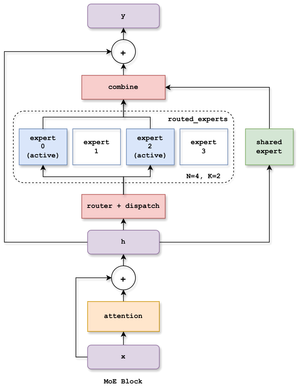
Allen Institute for AI technical report.MoE training costs scale with total parameter capacity, not just active compute, so infrastructure built for dense models loses throughput as experts are added. We redesign the Olmo-core training stack around DDP with expert and pipeline parallelism, adding NVSHMEM-based rowwise expert parallelism, synchronization-free routing with device-scheduled grouped GEMMs, and integrated MXFP8. On B300 nodes, the stack trains models from 12.9B to 1.2T total parameters on up to 512 GPUs, reaching 858 TFLOP/s/GPU at 1.2T. We also identify Token Gerrymandering, where the MoE router learns to hack the load-balancing loss.
-
Jun 2026
MAI-Thinking-1

Microsoft AI technical report.MAI-Thinking-1 is a 35B active / 1T total parameter MoE reasoning model trained from scratch (without distillation from third-party models). We present a scaling-focused pre-training framework paired with a robust RL recipe and infrastructure that sustains long, log-linear improvement. It is competitive with frontier models of similar size on STEM reasoning and coding.
-
Mar 2026
Olmo Hybrid

Conference on Language Modeling (COLM) 2026.We provide evidence that hybrid models, which mix attention and linear RNN layers, improve on pure transformers on several fronts. Theoretically, hybrids can express tasks beyond both transformers and linear RNNs individually; empirically, they scale more efficiently. We train Olmo Hybrid, a 7B model that replaces sliding-window layers with Gated DeltaNet layers, and show it outperforms Olmo 3 on standard pretraining and long-context evaluations.
-
Nov 2025
Olmo 3

arXiv preprint arXiv:2512.13961.We introduce Olmo 3, a family of state-of-the-art, fully-open language models at the 7B and 32B parameter scales. Olmo 3 model construction targets long-context reasoning, function calling, coding, instruction following, general chat, and knowledge recall. This release includes the entire model flow, i.e., the full lifecycle of the family of models, including every stage, checkpoint, data point, and dependency used to build it. Our flagship model, Olmo 3 32B Think, is the strongest fully-open thinking model released to-date.


Projects & Open Source
-
greyhound
I've been using greyhound as a place to build and experiment with CuTe DSL kernels for PyTorch, with an eye toward making training and inference workloads faster and easier to hack on. So far it includes kernels for cross-entropy and chunked linear losses, selective log-softmax, and causal Conv1D; see the greyhound documentation and benchmarks.
-
olmo-core
Building blocks for OLMo modeling and distributed training. I did substantial work in OLMo-core on pretraining and model development, including MFU improvements, scaling ladders, and the training infrastructure used for OLMo 3 and OLMo Hybrid.
-
Liger-Kernel
I contribute to Liger-Kernel, a collection of custom Triton kernels for efficient LLM training. I've found these kernels very useful for training LLMs/VLMs on my RTX 4090. My contributions, as well as those of other top collaborators, were featured in LinkedIn Engineering's overview of the Liger-Kernel ecosystem.
-
microR1
A micro-scale DeepSeek-R1 reproduction in the style of Karpathy's nanoGPT. Intended to be easy to understand and to hack on top of.
Favorite Reads
-
AI/ML Translations
English translations of selected posts from Chinese-language AI/ML blogs and forums.
-
Multi-Teacher On-Policy Distillation
Yumo Xu on combining on-policy distillation with multiple teacher models — a clear walkthrough of the method and tradeoffs.
-
The Ultra-Scale Playbook: Training LLMs on GPU Clusters
A detailed guide to large-scale training of LLMs, covering 1D through 5D training parallelism, GPU fusing and threading, and more.
-
How to Scale Your Model: A Systems View of LLMs on TPUs
An online book that explains how TPU and GPU hardware works and how the Transformer architecture has evolved to perform well on current hardware.
-
Making Deep Learning Go Brrrr From First Principles
A great post by Horace He explaining how to speed up single-GPU training based on whether jobs are compute-, bandwidth-, or overhead-bound. See also What Shapes Do Matrix Multiplications Like?
-
siboehm
An excellent ML engineering blog by Simon Boehm, and a large part of the inspiration for this site. I especially recommend Simon’s posts on optimizing multidimensional matrix multiplication on CPU and pipeline parallelism for distributed training.
-
ezyang’s blog
Edward Yang's insightful blog on distributed ML systems. I especially like Computing sharding with einsum.
-
Simon Willison’s Weblog
An insightful collection of links, quotes, and short blog posts that helps navigate the firehose of ML news.
-
Interconnects
A Substack with long-form technical posts about AI R&D by Nathan Lambert. Also see Nathan's RLHF Book.
Fun Stuff
-
Recipe Box
I find great joy in the process of cooking and I like to keep a recipe box of my favorite dishes.
-
How this startup used AI to keep raccoons from invading my house
My friends and I help a Seattle tech reporter keep some curious raccoons out of his living room. Related: Found a raccoon in the living room — now seeking a tech solution so it doesn’t happen again